Why City Island Rowing

Smallness is the mechanism

Most clubs will tell you bigger is better. We made a different bet — and everything that follows is what it pays for.

I · Why Rowing

The sport with no bench

Rowing is like no other sport a girl can choose. There is no bench. No substitutions, no garbage time, no being sent to the corner in the last two minutes hoping the ball doesn't find you. The same crew races from start to finish, with nobody on the sideline calling the next play. Everyone in the boat is treated as essential — because everyone is — and every girl is expected to live up to that.

That structure teaches what most sports only talk about. A rower is accountable for herself, her equipment, and her safety. And because a boat is only as strong as its weakest seat, getting better is not a private ambition — it's something she owes the girls in front of her and behind her. Nobody rises alone in this sport, and nobody gets left behind either. It is an extraordinary engine for personal growth.

And the world has noticed. The people who evaluate young people for a living — college admissions officers first, employers later — know exactly what a rower is: someone fluent in hard work, teamwork, discipline, and focus, who chose the sport where no one could be substituted in to do it for her. It's no accident that rowers are actively sought out, first by universities, then by the people who hire.

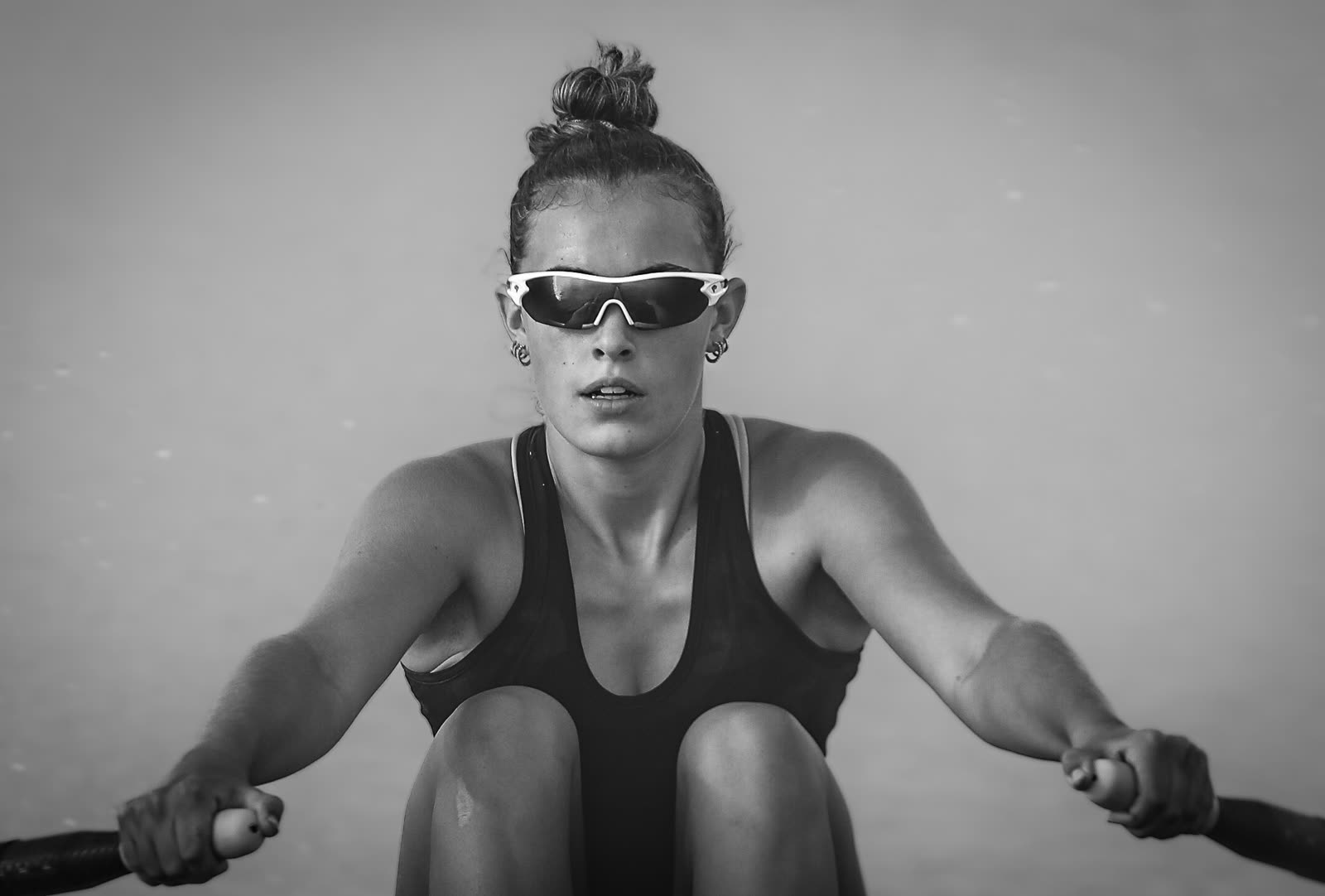
A rower at full focus, hands on the oars
II · Why City Island Rowing

Everybody knows everyone's name

City Island Rowing is the only all-girls club program in our area. That matters for a simple reason: our athletes get to be athletes. Nobody is thinking about who's watching, what they look like, or who they're impressing. They're thinking about the catch.

And we are small — deliberately. Every senior knows every incoming rower's name within her first week — they greet each other by name at the gate. Coaches know every athlete's stroke and every athlete's week. Sister groups, mixed boats, real mentorship: none of that works at 200 rowers. Smallness isn't something we apologize for. It's the design decision everything else depends on.

That's the promise a club this size can make and a machine cannot: your daughter will be known here. She is not a cog in a results chain, not a line on a revenue sheet, not an erg score with a name attached. Rowing done right builds a person — and you cannot build a person you haven't bothered to know.

Athletes in a circle looking down at the camera
The Mixed Boat

A younger athlete doesn't get told about slide control, set, and focus. She sits in a boat with her idols and feels it.

Sessions here mostly run by age group — but periodically, we fully mix the boats. A U16 rower takes her seat in a hull with the seniors she watches on Instagram, and for ninety minutes she experiences what an early catch actually feels like, what a set boat actually sounds like, how quiet real focus is.

Plenty of clubs claim a mentorship program. A mixed boat is mentorship demonstrated instead of asserted — and it's ours.

Sister groups

Every senior takes four or five "littles" — spread across the grades so each family group looks like the club in miniature. That's her family for the year: race-day logistics, 2K prep, carpools, gear questions, stroke problems, apple picking in the fall. New athletes never wonder who to ask. Their big already texted them.

An alumnae network that actually calls back

Our alumnae visit constantly, especially from their college programs. And the real value isn't "what's your school like?" It's that each of them vetted five or ten programs and can tell a junior exactly why they walked away from the ones they walked away from. No college counselor can offer that. Neither can a club too big to remember its graduates.

City Island Rowing takes young girls from
"I've never done this" to "Watch me!"

III · College Rowing

The payoff nobody plans for in 7th grade — and should

In 1976, Title IX had been law for four years and gone largely unenforced. Then the Yale women's crew — nineteen rowers, led by Chris Ernst — walked into an administrator's office and forced the issue, and the story went national. Every girl on a college roster today, in any sport, is downstream of what those rowers started. Rowing isn't an obscure boat sport. It's where the opportunities your daughter already takes for granted began.

Now the numbers. For decades, NCAA Division I women's rowing carried 20 scholarships per team — the largest allotment of any women's college sport. Under the NCAA's new roster rules, a Division I program can now carry — and fund — up to 68 rowers. Compare the crowd chasing those seats: hundreds of thousands of girls play high school soccer and basketball, and fewer than one in twelve soccer players — one in twenty for basketball — ever compete in the NCAA at any level. Rowing's pool of high school athletes is a tiny fraction of that, competing for some 7,500 college seats. Most parents weighing sports for a 7th grader have never heard that ratio. The ratio is the argument.

High-school rowing is, quite simply, the best vector into college recruiting a girl can choose.

And the fear underneath the question — "my daughter isn't an athlete yet; is she already too late?" — has a clean answer: no. Rowing recruits late. While other sports fill their rosters years in advance, most rowing offers land in senior year, some in junior year. This sport prizes height, trainability, and work ethic far more than early achievement. A girl who starts in 9th, 10th, even 11th grade is right on time.

City Island Rowing's recruiting record is nationally respected. The vast majority of our athletes go on to row in college, many with partial or full scholarships. City Island Rowing has sent multiple athletes to every Ivy and to the most competitive D1, D2, and D3 programs in the country — and our reputation is for placing girls in schools that genuinely fit them, not just schools that collect them.

One thing we want said plainly: recruiting is what happens to girls who stay in the sport and stay healthy. It's the payoff — not the reason to start. Which brings us to how we train.

IV · How We Train

Twelve hours, spent well

The NCAA caps college athletes at 20 hours of training a week. Some high school programs in this area train near or at that number — and that is absurd. A teenager needs time for academics, for family, for interests beyond her sport, and above all for the rest and recovery a growing body demands.

City Island Rowing trains about 12 hours a week — and remains regionally and nationally competitive with crews that train 16 and 18, qualifying boats for Youth Nationals year after year. That is not a wellness claim. It's a performance claim: we are better at turning an hour of training into boat speed. Precise technical work, focused erg pieces, real recovery. The stopwatch doesn't care how tired you are; it cares how fast you are.

The sports-medicine consensus is blunt: growing bodies need rest, and overtraining in adolescence is where overuse injuries are born. We'd rather your daughter still love this sport at 22.

Rowing itself has an honest flaw: sweep rowing loads the body asymmetrically — leaning and twisting to one side — and a growing back is exactly the wrong place for that. Your athlete's safety is our first responsibility, so every CIR athlete starts in sculling, the symmetrical, lighter-loaded discipline: singles, doubles, quads, even our octuple. When our athletes sweep, they learn both sides, port and starboard, so their bodies develop in balance. In much of this sport, a girl is assigned a side in her first week and rows it for the rest of her career. We don't do that to a growing back.

And one thing City Island Rowing will never be: an assembly line. There are programs in this sport that process athletes like parts in a results machine — enormous volume, winning above all else, the child a cog in someone's business model. They produce fast boats, and they produce worn-out seventeen-year-olds who arrive at college already tired of the water. We would rather build the athlete than spend her.

Athlete focused on the erg
Every Ivy
Has taken CIR athletes
68
Roster seats at one D-I rowing program
12
Hours a week we train
Nationals
Qualified year after year

See it for yourself

The fastest way to understand this club is a week inside it. Fall season starts September 7.